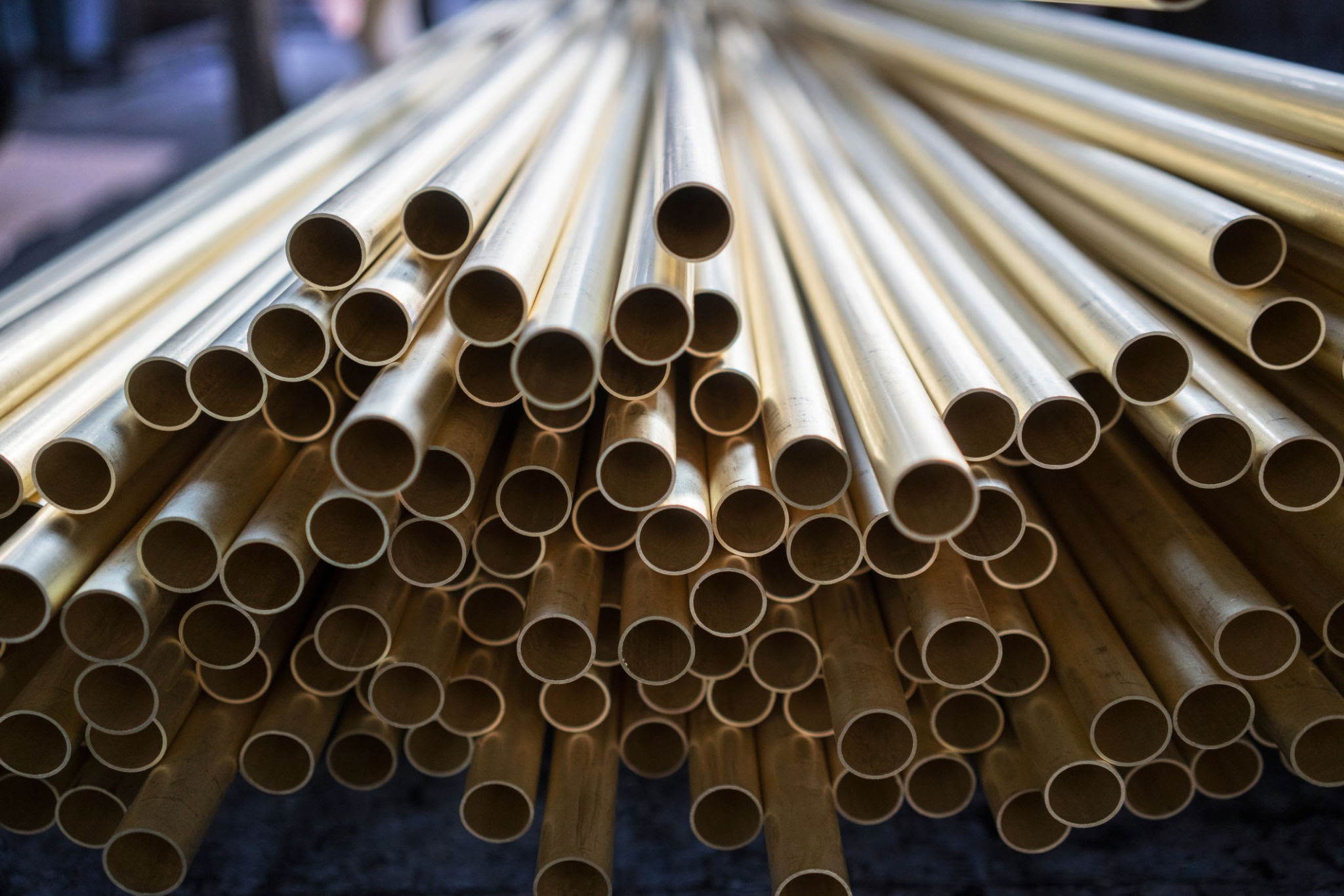
METALCO supplies copper, brass, and bronze semi-finished products for OEMs and
distributors worldwide — with documented quality, export packing, and technical
support you can rely on.
Get a free quote
Share your alloy grade, form, and quantity — our team will respond with lead time and documentation.
The Ultimate Guide to ASME SB111 / ASTM B111 C44300 Admiralty Brass Tubes
June 23, 2026
The Ultimate Guide to ASME SB111 / ASTM B111 C44300 Admiralty Brass Tubes
Navigating the material selection process for high-stakes industrial heat exchangers and condensers can be challenging. If your operations demand exceptional corrosion resistance in brackish or seawater environments, ASME C44300 / ASTM B111 C44300 Admiralty Brass Tubes are often the gold standard.
In this comprehensive guide, we break down everything you need to know about C44300 brass tubes—from chemical composition and mechanical properties to their most common industrial applications.
Material Overview: What is C44300 Admiralty Brass?
C44300 Admiralty Brass is a copper-zinc-tin alloy specifically engineered for optimum corrosion resistance in harsh, corrosive environments. By adding a precise amount of Tin (Sn) and a trace amount of Arsenic (As), this alloy effectively resists dezincification—a common form of corrosion where zinc leaches out of the alloy, weakening the structure.
ASME SB111: The standard specification for copper and copper-alloy seamless condenser tubes and ferrule stock.
ASTM B111: The corresponding standard covering seamless tubes for heat exchangers.
Chemical Composition of C44300
The unique balance of elements in C44300 is what gives it its legendary durability. The addition of arsenic acts as an inhibitor against corrosive attack in saline water.
Element
Percentage (%)
Copper (Cu)
70.0 – 73.0%
Tin (Sn)
0.9 – 1.2%
Arsenic (As)
0.02 – 0.06%
Lead (Pb)
0.06% max
Iron (Fe)
0.06% max
Zinc (Zn)
Remainder
Mechanical Properties
C44300 tubes offer an excellent balance of strength and ductility, allowing them to be easily expanded into tube sheets while maintaining structural integrity under high pressure.
Property
Metric
Imperial
Tensile Strength
≥ 310 MPa
≥ 45,000 psi
Yield Strength
≥ 105 MPa
≥ 15,000 psi
Elongation (in 2 inches)
≥ 35%
≥ 35%
Rockwell Hardness
55–75 HRB
55–75 HRB
Core Industrial Applications
Because of their superior thermal conductivity and resistance to biofouling and corrosion, ASTM B111 C44300 tubes are heavily utilized in heavy industries:
Marine & Shipbuilding: Condenser systems, cooling water lines, and salt-world piping.
Oil & Gas Refineries: Heat exchangers handling corrosive hydrocarbon streams mixed with cooling water.
Power Generation: Steam surface condensers and evaporator tubing.
Desalination Plants: Distillation units and pre-heaters operating in high-salinity environments.
Chemical Processing: Equipment processing mildly aggressive chemical solutions.
Frequently Asked Questions (FAQ)
What is the difference between ASME SB111 and ASTM B111?
Practically speaking, they are nearly identical. ASTM B111 is the standard published by the American Society for Testing and Materials for commercial use. ASME SB111 is approved by the American Society of Mechanical Engineers for use in pressurized systems (like boilers and pressure vessels) governed by the ASME Boiler and Pressure Vessel Code (BPVC).
Why is Tin added to C44300 Admiralty Brass?
Tin improves the alloy's resistance to general corrosion and pitting, particularly in fast-flowing seawater and brackish water environments.
Does C44300 resist stress corrosion cracking (SCC)?
While C44300 has excellent resistance to dezincification, like most brasses, it can be susceptible to Stress Corrosion Cracking (SCC) in the presence of ammonia or specific moisture conditions. To minimize this risk, the tubes are typically supplied in an annealed (O61) temper to relieve internal manufacturing stresses.
How does C44300 compare to C70600 (Copper-Nickel 90/10)?
While Copper-Nickel (C70600) offers superior erosion-corrosion resistance at higher water velocities, C44300 Admiralty Brass is generally more cost-effective for moderate velocity applications while still offering superb thermal efficiency.
Partner with a Trusted C44300 Tube Supplier
Looking for reliable, certified, and precisely engineered ASME SB111 / ASTM B111 C44300 Admiralty Brass Tubes for your next project? We supply high-grade tubing tailored to your exact dimensional tolerances.
Admiralty Brass Tubes are copper-zinc alloy tubes widely used in condensers, heat exchangers, evaporators, oil coolers, and marine applications. They are valued for good corrosion resistance, excellent thermal conductivity, and reliable performance in cooling water service.
2. What is the composition of Admiralty Brass?
Admiralty Brass generally contains copper and zinc with a small addition of tin. The tin improves resistance to corrosion, especially in water-based and mildly aggressive service conditions.
3. What is the use of Admiralty Brass Tubes?
Admiralty Brass Tubes are mainly used in:
Surface condensers
Shell and tube heat exchangers
Oil coolers
Intercoolers
Evaporators
Desalination plants
Power plants
Sugar plants
Refineries
Shipbuilding and marine cooling systems
4. Why are Admiralty Brass Tubes used in condensers?
Admiralty Brass Tubes are used in condensers because they offer a strong balance of:
Heat transfer efficiency
Corrosion resistance in cooling water
Good mechanical workability
Long service life in properly maintained systems
5. What are the advantages of Admiralty Brass Tubes?
Key advantages include:
Good thermal conductivity
Good resistance to corrosion in clean water service
Easy fabrication and expansion into tube sheets
Good strength and durability
Cost-effective solution for many condenser and heat exchanger applications
6. What is the difference between Admiralty Brass and Copper Nickel Tubes?
Admiralty Brass is typically preferred for general condenser and heat exchanger service, while Copper Nickel Tubes are often selected for more severe marine and seawater applications because Copper Nickel offers higher resistance to biofouling and seawater corrosion in many operating environments.
7. What is the difference between Admiralty Brass and Aluminium Brass Tubes?
Admiralty Brass and Aluminium Brass are both used in heat exchanger and condenser applications. However, Aluminium Brass is often preferred for higher resistance in certain cooling water and seawater conditions, while Admiralty Brass remains a widely used and economical option in many industrial services.
8. Are Admiralty Brass Tubes suitable for seawater applications?
Admiralty Brass Tubes can be used in certain water and marine-related applications, but suitability depends on water quality, flow velocity, temperature, system design, and maintenance conditions. For more aggressive seawater duty, Copper Nickel or Aluminium Brass may also be considered depending on the application.
9. What are the common grades of Admiralty Brass Tubes?
Common Admiralty Brass grades include C44300 and related specifications depending on the standard and project requirement.
10. What is C44300 Admiralty Brass Tube?
C44300 is one of the most commonly specified Admiralty Brass grades used for heat exchanger and condenser tube applications. It is known for good corrosion resistance and reliable heat transfer properties.
11. What standards are used for Admiralty Brass Tubes?
Admiralty Brass Tubes are commonly supplied as per international standards such as:
ASTM / ASME specifications
BS / EN equivalent requirements
Customer-specific project standards
Heat exchanger and condenser tubing specifications
12. What sizes are available in Admiralty Brass Tubes?
Admiralty Brass Tubes can be supplied in a wide range of:
Outside diameters
Wall thicknesses
Cut lengths
Long lengths
Straight lengths
U-bend tubes (depending on requirement)
13. Are Admiralty Brass Tubes available in straight lengths?
Yes, Admiralty Brass Tubes are commonly supplied in straight lengths for condenser, heat exchanger, and general engineering applications.
14. Can Admiralty Brass Tubes be supplied in U-bend form?
Yes, depending on manufacturing capability and project requirement, Admiralty Brass Tubes can be supplied in U-bend configuration for heat exchanger and condenser applications.
15. Are Admiralty Brass Tubes seamless?
Admiralty Brass Tubes are generally supplied as seamless tubes for critical heat transfer and pressure applications, subject to applicable standards and manufacturing route.
16. What is the temper condition of Admiralty Brass Tubes?
Admiralty Brass Tubes can be supplied in different temper conditions depending on the application, forming requirements, and relevant standard.
17. Are Admiralty Brass Tubes suitable for heat exchangers?
Yes, Admiralty Brass Tubes are widely used in shell and tube heat exchangers due to their good heat transfer characteristics and corrosion performance in suitable service conditions.
18. Can Admiralty Brass Tubes be used in power plants?
Yes, Admiralty Brass Tubes are commonly used in power plant condensers and cooling systems where the operating conditions match the alloy’s performance characteristics.
19. Are Admiralty Brass Tubes used in marine applications?
Yes, Admiralty Brass Tubes are used in marine condensers, coolers, and onboard heat exchange equipment, depending on system water quality and design requirements.
20. What industries use Admiralty Brass Tubes?
Industries include:
Power generation
Marine and shipbuilding
Refineries
Petrochemicals
Fertilizer plants
HVAC
Sugar plants
Distilleries
Desalination and water treatment
Process industries
21. What are the corrosion-resistant properties of Admiralty Brass Tubes?
Admiralty Brass Tubes provide good resistance to corrosion in many cooling water applications. Their performance depends on water chemistry, oxygen content, pH, suspended solids, and flow conditions.
22. Can Admiralty Brass Tubes handle high temperatures?
They are used in heat transfer applications involving elevated temperatures, but the exact suitability depends on design pressure, temperature range, media, and project specification.
23. Are Admiralty Brass Tubes easy to fabricate?
Yes, Admiralty Brass Tubes are generally known for good workability and can be used for:
Cutting
Bending
Expanding
Flaring
Tube sheet installation subject to standard fabrication practices.
24. What is the thermal conductivity of Admiralty Brass Tubes?
Admiralty Brass Tubes offer good thermal conductivity, which makes them suitable for condenser and heat exchanger service where efficient heat transfer is important.
25. Are Admiralty Brass Tubes suitable for replacement of old condenser tubes?
Yes, they are commonly used for retubing and replacement projects in condensers, coolers, and heat exchangers, provided the alloy matches the service condition and design requirement.
26. Can Admiralty Brass Tubes be custom cut?
Yes, tubes can typically be supplied in custom lengths and project-specific dimensions based on customer requirements.
27. Do Admiralty Brass Tubes require testing?
Yes, tubes may be supplied with required inspection and testing such as:
Dimensional inspection
Eddy current test
Hydro test
Mechanical tests
Flattening / flaring tests
Material identification and certification depending on standard and order requirements.
28. Are third-party inspection and mill test certificates available?
Yes, material can typically be supplied with Mill Test Certificates (MTC) and third-party inspection as per project requirement.
29. What should buyers check before ordering Admiralty Brass Tubes?
Buyers should confirm:
Grade / specification
Tube OD and wall thickness
Length
Temper condition
Application
Testing requirements
Documentation / MTC
Quantity
Packing and delivery requirement
30. How do I choose the right Admiralty Brass Tube supplier?
Choose a supplier based on:
Manufacturing quality
Export capability
Size range
Testing facilities
Documentation support
Packaging quality
Experience in condenser and heat exchanger tubing
Ability to meet project timelines
31. Can Admiralty Brass Tubes be exported worldwide?
Yes, Admiralty Brass Tubes are widely supplied for export to power, marine, HVAC, refinery, and industrial projects worldwide.
32. Why buy Admiralty Brass Tubes from Metal Alloys Corporation?
Metal Alloys Corporation supplies Admiralty Brass Tubes for condenser, heat exchanger, and industrial applications with focus on quality, export packaging, technical support, and project-oriented supply.